Many businesses invest heavily in traffic acquisition – SEO, ads, social media – yet struggle to convert visitors into users or customers. When this happens, marketing is often blamed first. However, in most modern web products, conversion failure is a UI/UX problem.
Users decide whether to trust, engage, or leave a product within seconds. That decision is driven not by marketing copy alone, but by how intuitive, clear, and reassuring the interface feels. In today’s competitive digital landscape, UI/UX design directly influences conversion rates, making it a core business function rather than a cosmetic layer.
What “Conversion” Really Means in UI/UX
In UI/UX terms, a conversion is any meaningful user action, such as:
-> Signing up for a product or newsletter
-> Submitting a lead form
-> Booking a demo or consultation
-> Completing a purchase
-> Successfully onboarding into a platform
From a UX perspective, conversion is the outcome of user confidence, reduced friction, and clarity of intent. If users hesitate, get confused, or feel uncertain at any step, conversions drop—even if the product itself is strong.
First Impressions: UI Credibility Equals Trust
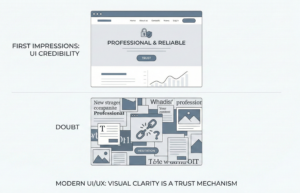
Users subconsciously evaluate a product’s credibility almost instantly. Clean layouts, consistent typography, balanced spacing, and thoughtful color usage signal professionalism and reliability.
Poor UI choices – cluttered layouts, inconsistent styles, or outdated visuals – create doubt before users even engage with the content. This hesitation directly affects conversion rates, especially in SaaS platforms, fintech products, and service-based websites where trust is critical.
In modern UI/UX design, visual clarity is not aesthetic preference – it is a trust mechanism.
UX Friction: The Silent Conversion Killer
UX friction refers to anything that slows users down or makes them think unnecessarily. Common examples include:
- -> Too many form fields
- -> Confusing navigation structures
- -> Unclear CTAs
- -> Forced account creation
- -> Inconsistent mobile experiences
Every additional cognitive decision increases the chance of drop-off. High-converting products focus on reducing effort at every step, allowing users to move forward without uncertainty.
Good UX removes obstacles users don’t even realize they are facing.
UI/UX as an Ongoing Optimization Process
High-performing products treat UI/UX as a continuous process, not a one-time design task. User behavior evolves, expectations change, and products grow in complexity.
This data-driven approach ensures that UI/UX continues to support conversion growth over time.
How Triosphere Tech Approaches Conversion-Focused UI/UX
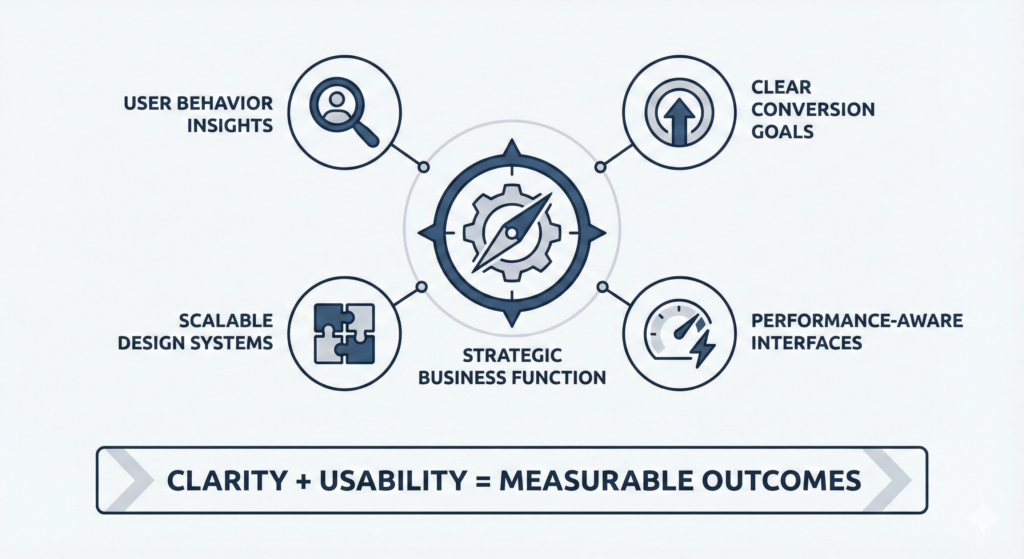
At Triosphere Tech, UI/UX design is approached as a strategic business function. Design decisions are driven by:
-> User behavior insights
-> Clear conversion goals
-> Scalable design systems
-> Performance-aware interfaces
Rather than focusing on visual appeal alone, the emphasis is on clarity, usability, and measurable outcomes—ensuring that design supports both users and business objectives.
Conclusion: Better UX Creates Better Business Outcomes
In modern web products, UI/UX design directly influences whether users convert, engage, or leave. A well-designed interface builds trust, removes friction, and guides users effortlessly toward action.
Businesses that invest in conversion-focused UI/UX gain more than better design—they gain higher engagement, lower churn, and sustainable growth. In a crowded digital market, great UX is no longer optional; it is a competitive advantage.