

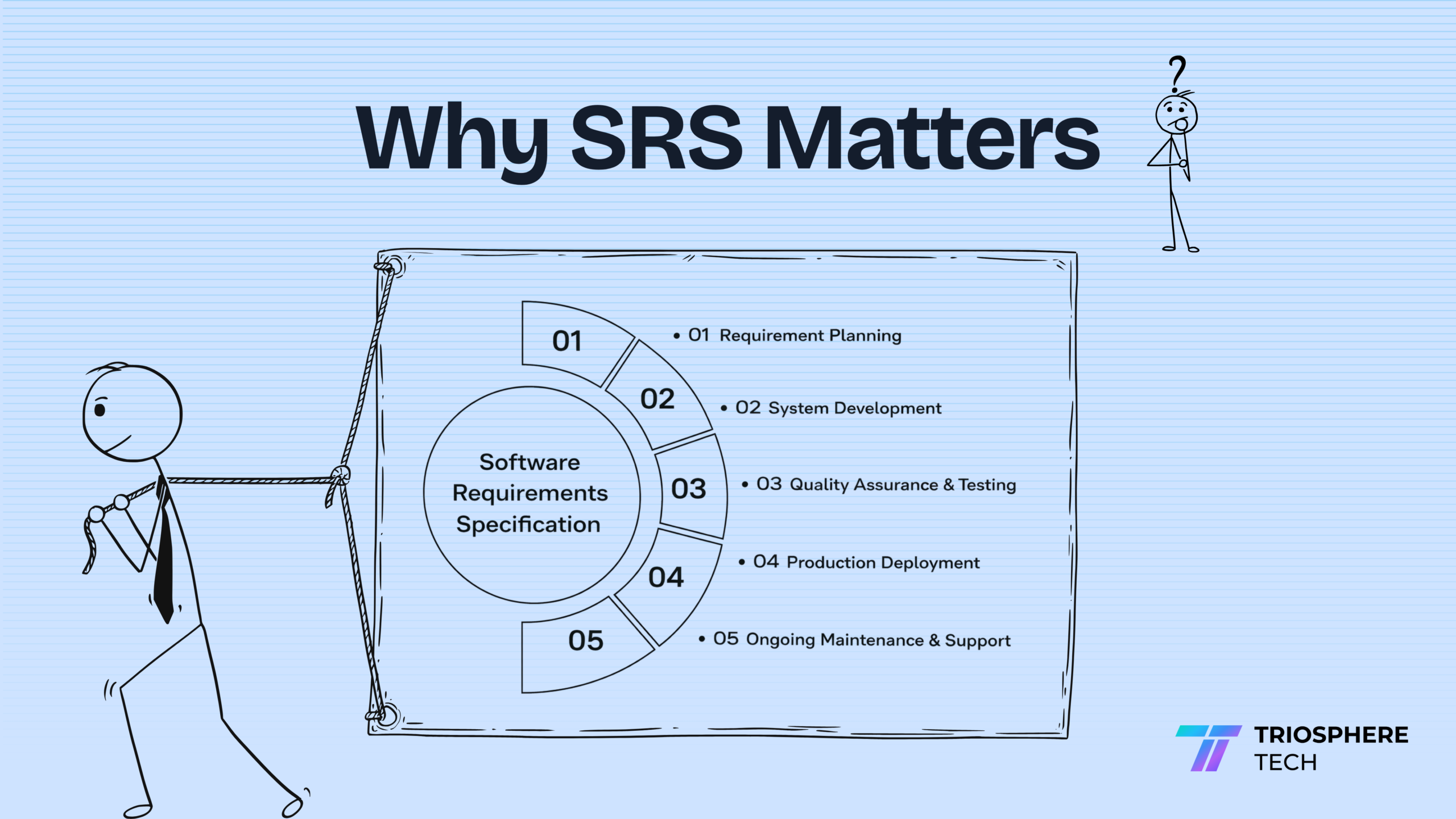
At Triosphere Tech, we strongly believe that a well-defined SRS is not just a document—it is the foundation of a successful, scalable, and future-ready software product. In this blog, we’ll explain what an SRS is, why it’s required before starting a new project, and how it aligns with industry standards.
A Software Requirements Specification (SRS) is a formal document that clearly defines what a software system should do and how it should perform. It serves as a single source of truth for all stakeholders—clients, developers, designers, testers, and project managers.
An SRS answers critical questions such as:
What problem is the software solving?
Who are the end users?
What features and functionalities are required?
What are the performance, security, and compliance expectations?
Industry-standard SRS documents often follow IEEE 830 / ISO/IEC/IEEE 29148 guidelines.
Starting development without an SRS is like constructing a building without blueprints. Here’s why an SRS is mandatory before any serious project begins:
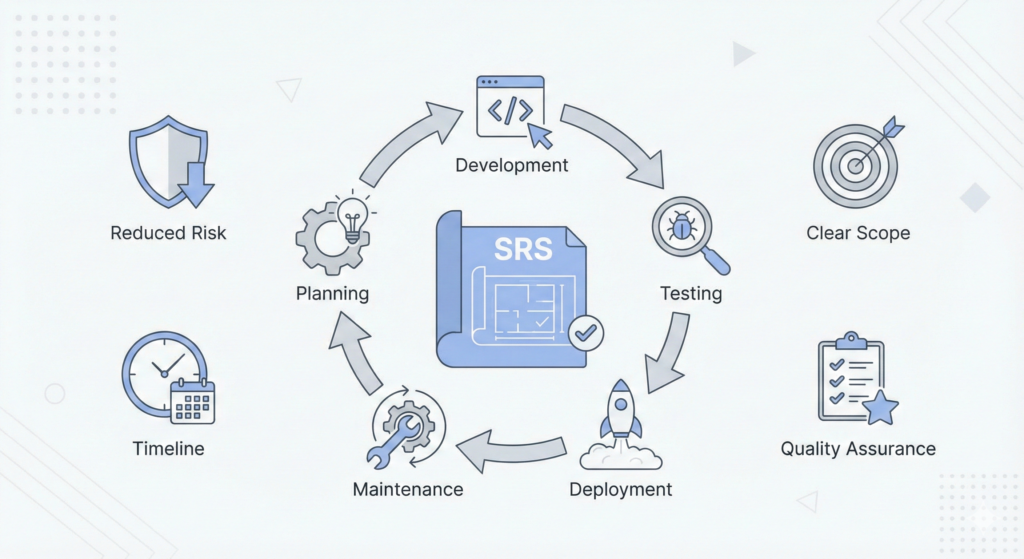
An SRS eliminates assumptions and ensures that everyone shares the same understanding of the project goals.
It clearly states what is in scope and out of scope, preventing scope creep and unnecessary rework.
With clear requirements, development teams can estimate effort, cost, and delivery timelines more accurately.
The SRS acts as a communication bridge between technical and non-technical stakeholders.
A professional SRS typically includes the following sections:
Product perspective
User classes and characteristics
Operating environment
Design and implementation constraints
Detailed system features
User flows and use cases
Business logic and workflows
Performance requirements
Security standards
Scalability and availability
Compliance and legal requirements
User interfaces (UI/UX)
APIs and third-party integrations
Hardware or software dependencies
Technical assumptions
Business dependencies
An SRS is not just for developers—it delivers measurable business value:
Reduced development risks
Lower maintenance and rework costs
Improved product quality
Faster onboarding of new team members
Easier testing and validation
Stronger client–vendor trust
At Triosphere Tech, projects with a strong SRS typically experience improved delivery timelines and higher overall development efficiency.
Skipping the SRS phase can lead to:
Frequent requirement changes
Misaligned expectations
Increased development cost
Delayed launches
Poor end-user experience
In worst cases, projects fail entirely—not due to lack of talent, but due to lack of clarity.
A common misconception is that SRS is only for traditional waterfall projects. In reality:
Agile teams use lightweight, evolving SRS documents
User stories and backlogs are derived from SRS requirements
It provides a stable vision while allowing iterative improvements
An SRS does not restrict agility—it enables controlled flexibility.
At Triosphere Tech, while we may not offer standalone SRS documentation as an independent service, we strongly follow an SRS-driven approach for every project we deliver.
Before development begins, our team ensures that requirements are:
Clearly understood and validated with stakeholders
Properly structured and aligned with business goals
Translated into actionable technical and functional specifications
We integrate requirement clarity into our core services such as:
Web application development
Mobile app development
Custom software solutions
Enterprise and SaaS platforms
By following a structured requirement analysis process internally, we ensure:
Minimal ambiguity during development
Reduced rework and change requests
Better alignment between client expectations and final delivery
-> Scalable and future-ready solutions
Our philosophy is simple: clear requirements lead to successful execution.
A Software Requirements Specification is not optional—it is essential. It saves time, cost, and effort while ensuring that your project delivers real business value.
Before writing a single line of code, invest in clarity. Invest in an SRS.
If you’re planning a new digital product and want a structured, risk-aware development approach, Triosphere Tech can guide you from requirement clarity to successful execution.
🌐 Visit us at: https://triospheretech.com

We are a leading tech company dedicated to crafting innovative digital solutions for businesses worldwide. At Triosphere Tech, we believe in the power of technology to transform ideas into reality and drive growth.